Letter #001
The Art of Noticing: A Reflection on Paper Boats
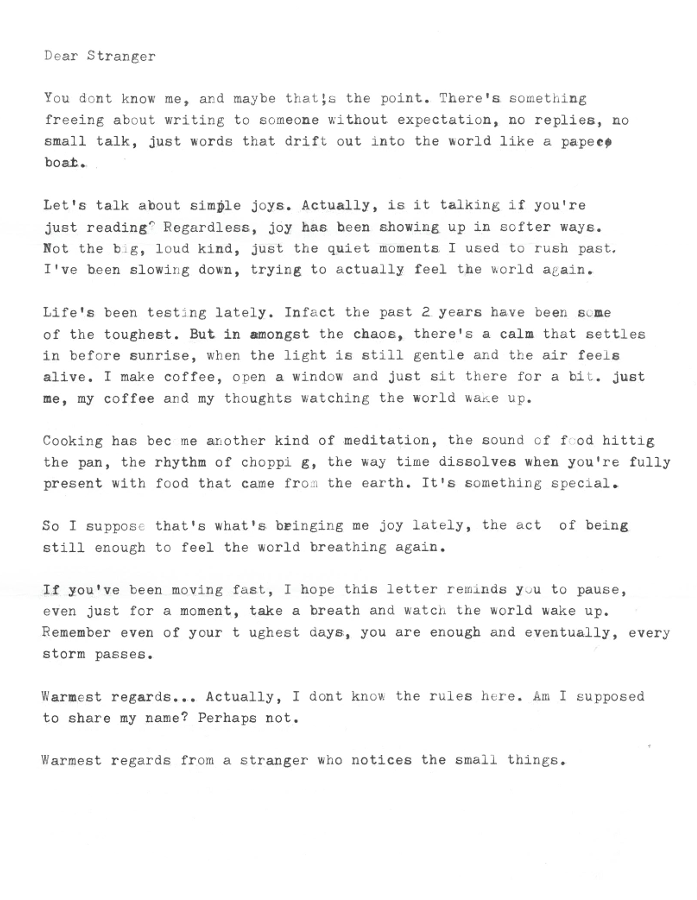
There are letters that arrive like appointments, and there are letters that drift in; unbidden, unaddressed. Like the soft rustle of leaves outside a window. Paper Boats is the latter. It does not knock. It does not introduce itself. It simply enters, trailing with it the scent of morning light, the hush of early coffee, and the rare gift of being spoken to without expectation.
What makes this letter remarkable is not what it tells, but how it watches. The tone is hushed, unhurried, almost ceremonial in its attention. The writer is not confiding so much as composing a moment; one in which life slows to the pace of breath, and meaning is rediscovered in the ordinary.
It is a letter shaped not by narrative, but by noticing.
There is something in the way the world is not explained but observed, tenderly and without haste. The early hours of the morning become a kind of sanctuary. Steam rises from a mug like a quiet offering. A knife touches a chopping board with rhythm, not urgency. Time, which so often feels like a tyrant, softens into texture. The reader is not given a story, but a rhythm, a cadence; slow, domestic, reverent.
Joy, in this letter, is not loud. It is not performed. It arrives in “softer ways,” as the writer says, through ritual, repetition, and presence. This joy does not seek to impress. It is the kind that appears when no one is watching, when one is not performing for a timeline or trying to document beauty for others. It is the joy of being with the world, rather than ahead of it.
The letter’s emotional centre lies in its restraint. There is no urgency, no confessional burst, no reaching for drama. Instead, there is a calm endurance, a quiet kind of survival. “Life’s been testing lately,” the writer admits just that, with no embellishment. The chaos is acknowledged, but not dwelled upon. Instead, the focus turns toward the small and sacred: the acts that bring the body and the mind into the same room.
Cooking becomes a metaphor not for nourishment but for restoration. The slicing of food, the scent of heat, the silence between motions. These are not tasks, but returns. The kitchen is not a place of labor, but of grounding.
The writer chooses not to name themselves, not to claim space, only to offer presence. This anonymity is not a coy trick, it is a kind of generosity. To speak without name is to allow the words to belong to the reader as much as the writer. It is to invite intimacy without imposing identity.
The letter closes the way a gentle moment does: without conclusion, without summary. It lingers rather than ends. And in doing so, it stays with you, not in the form of an argument or an idea, but as a mood.
A pause.
A quiet tug toward stillness.
Paper Boats does not seek to explain, or to move you to action. It offers, instead, a gentler proposition: that attention is a kind of love. That presence is a form of care. And that even on the most uncertain of days, it is possible to return, to breath, to ritual, to yourself; through the act of simply noticing the world again.
It is a small letter. A quiet one. But like all truly beautiful things, it asks only this:
Let it find you. Let it slow you. Let it remind you what you already know.
And then… let it go.
– The Lonely & The Loved
 The lonely & the loved
Leave a comment